
How to Choose an Industrial Edge Gateway for Factory Data Acquisition
1. Why Do Factories Need an Industrial Edge Gateway?
Modern factories rely on PLCs, sensors, industrial instruments, and production equipment to keep operations running. These devices continuously generate data about equipment status, production output, process conditions, and inspection results. However, equipment from different manufacturers may use different interfaces, communication methods, and data formats. As a result, information can remain scattered across individual machines or subsystems, making centralized monitoring and maintenance more difficult.
An Industrial Edge Gateway is typically installed close to field devices. It connects equipment, collects data, and can perform preliminary data processing when required by the application. The collected information can then be forwarded to higher-level systems such as SCADA and MES, depending on the system architecture and supported communication methods. In this role, the gateway acts as a connection point between shop-floor equipment and the wider Industrial Internet of Things (IIoT) environment.
For manufacturers, the value of an Industrial Edge Gateway goes beyond simply connecting devices. A well-planned data acquisition setup can make equipment information easier to access, support centralized monitoring, and provide useful input for production analysis. Instead of upgrading an entire factory at once, businesses can begin with one production line, a group of machines, or a specific monitoring task and gradually expand the system as requirements develop.
A suitable gateway therefore needs to match both the connected equipment and the intended application. The number of interfaces, communication compatibility, operating environment, and future expansion requirements should all be considered before a model is selected.
2. Key Parameters to Consider When Selecting an Industrial Edge Gateway
When choosing an Industrial Edge Gateway, the processor is only one factor to consider. In practical deployments, interface compatibility, power requirements, and the ability to operate in the intended environment are equally important.
| Key Parameter | What to Check |
| CPU, memory, and storage | Choose according to data volume, local computing tasks, and software requirements. |
| Network and I/O interfaces | Confirm the types and number of LAN, RS-232/485, USB, and other required interfaces. |
| Power input and operating temperature | Check that the input voltage range and operating temperature meet site requirements. |
| Expansion capability | Review options for storage, wireless modules, and other expansion needs. |
| Operating system and compatibility | Confirm compatibility with Windows or Linux, required communication protocols, and upstream systems. |
Keep in mind that matching physical interfaces do not necessarily mean that communication protocols are compatible. Before purchasing, prepare a list of field devices and verify the interface configuration, software support, and installation requirements for the exact model.
3. HWAINTEK HG31 vs. HG33X: Specifications and Selection Guide
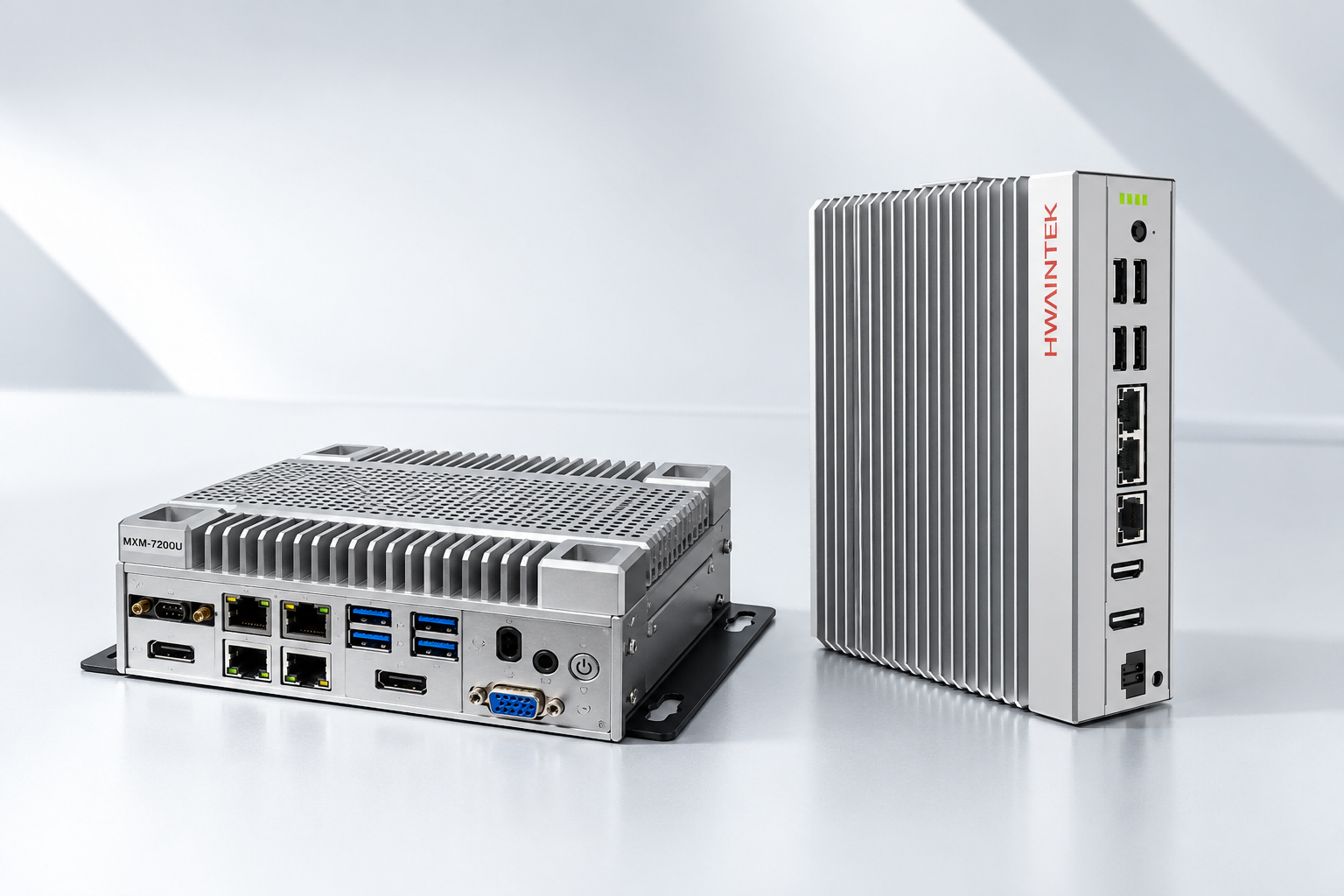
HWAINTEK's HG Series supports industrial edge computing and factory data acquisition applications. The HG31 and HG33X differ in network interfaces, power input, operating temperature, and available expansion options. Comparing these specifications against project requirements is more useful than choosing a model based on processor performance alone.
3.1 Key Specifications: HG31 vs. HG33X
| Parameter | HG31 | HG33X |
| Processor | Intel® J6412 / N97 configurations | Intel® J6412, N97, and selected 4th–12th Gen U-series configurations |
| Network interfaces | 3 × LAN | 2 × LAN standard; 4 × LAN optional |
| Display output | DP + HDMI | VGA + HDMI |
| Power input | 24V DC | 9–36V DC |
| Operating temperature | 0°C to 50°C, subject to specification requirements | -20°C to 70°C |
| Mounting | Wall mounting | Wall mounting; optional DIN-rail clip |
Note: The specifications above are summarized from the relevant product specifications. The HG33X is available with different processor and interface configurations; optional features listed here may not be available on every model. Memory type and capacity, interface combinations, and operating system versions should be confirmed against the exact configuration ordered.
3.2 When Should You Consider the HG31?
The HG31 IIoT Edge Gateway provides three LAN ports, DP and HDMI display outputs, and serial connectivity including RS-232/422/485 and RS-232. It may suit projects requiring multiple network connections or dual-display output, provided the connected devices match the available interfaces.
For industrial data acquisition applications, the HG31 can be considered when several devices need to connect to a single edge computing node. Before selection, confirm that the 24V DC power input matches the site's electrical design and that the installation environment meets the specified 0°C to 50°C operating range.
It is also important to check the complete interface configuration against the field-device list. Having multiple LAN ports can help accommodate network connections, but the final setup must still meet the communication requirements of the connected equipment.
3.3 When Should You Consider the HG33X?
The HG33X Series IIoT Edge Gateway offers different processor and hardware configurations, with options for network interfaces and storage expansion. It supports a 9–36V DC input range and an operating temperature of -20°C to 70°C. Selected configurations can also support additional LAN, CAN, or GPIO options.
The HG33X may be worth considering for projects that require a wider input-voltage range, a broader specified operating-temperature range, or particular expansion capabilities. These characteristics can be useful when evaluating hardware for different installation conditions.
However, available features vary by configuration. Before purchasing, confirm that the selected model provides the required interfaces and expansion options. A wider operating-temperature range or additional connection options should be assessed against the actual project requirements rather than treated as a guarantee of suitability for every environment.
4. Industrial Edge Gateway Applications Across Industries
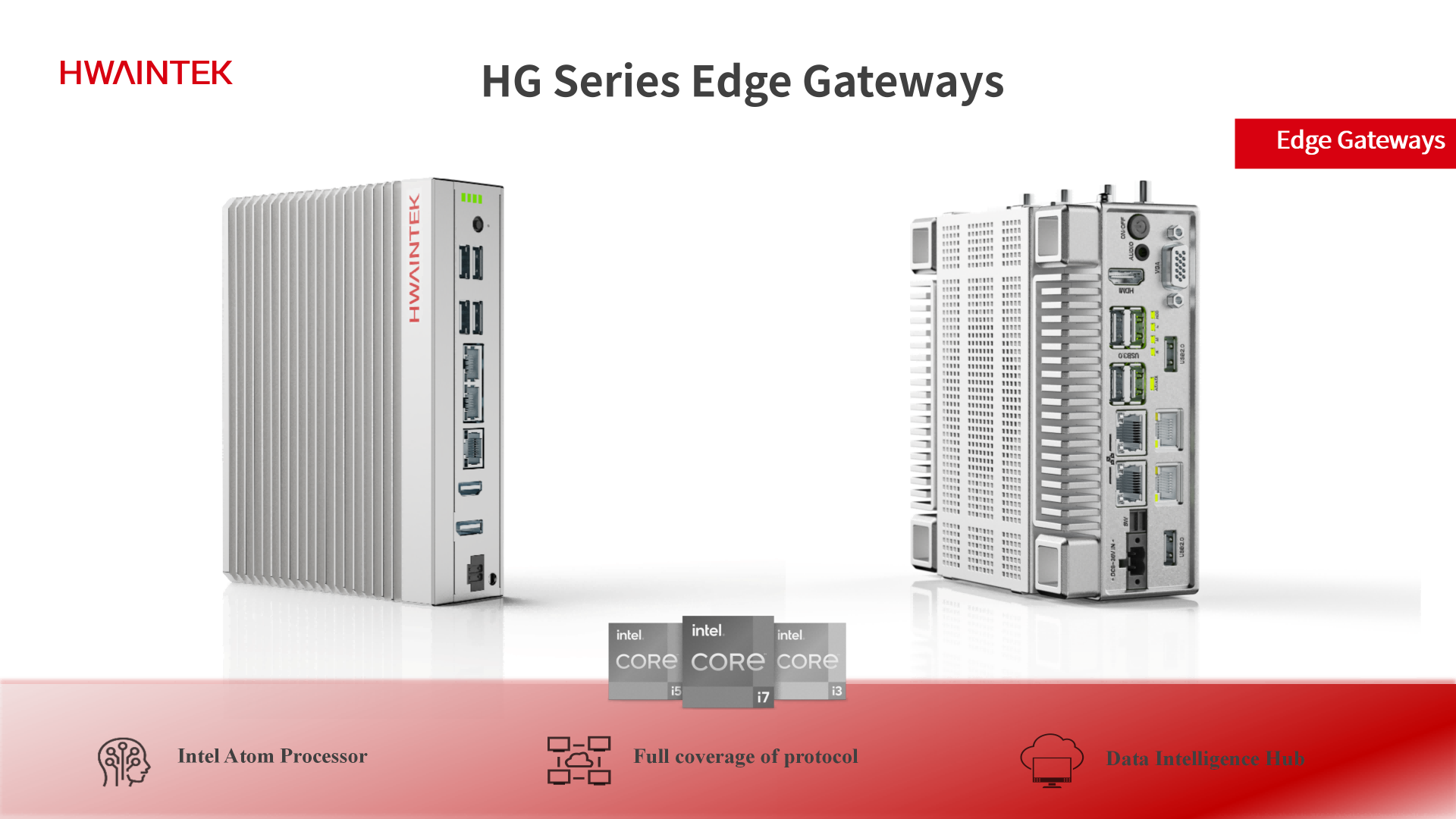
Industrial Edge Gateways can be used in a variety of industrial automation environments, but the selection priorities vary by application. Identifying the data sources, connected equipment, and business objectives helps narrow down the options for an IIoT Edge Gateway.
4.1 Discrete Manufacturing and Production-Line Data Acquisition
In electronics assembly and automotive parts manufacturing, factories may collect machine status, production output, and inspection data for centralized monitoring and analysis. LAN ports, serial interfaces, USB connectivity, and software compatibility are important when connecting different types of equipment.
If local machine-vision applications are also required, processor performance, memory, and storage should be assessed according to the workload. The gateway's role in the system should be clearly defined: collecting and forwarding data is different from performing more demanding local processing.
When connecting PLCs and other field devices to an MES, interface matching and communication protocol compatibility are essential for reliable data exchange. A gateway should be selected according to the complete data path, from the field equipment to the upper-level application.
Before deployment, it is useful to clarify which data needs to be collected, where it will be sent, and how it will be used. These details help determine the appropriate hardware configuration and reduce the risk of selecting equipment that does not match the actual application.
4.2 Energy, Equipment Monitoring, and Process Industries
In energy, water treatment, and other process industries, an Industrial Edge Gateway can connect field instruments and controllers with higher-level systems such as SCADA. Selection should focus on communication protocols, serial and LAN interfaces, power input, and operating temperature.
For demanding environments, check whether the specified voltage range, operating temperature, and mounting options meet the actual site conditions. The gateway should also be compatible with the software interfaces and data formats required by the monitoring system.
It is important to distinguish between collecting data and interpreting it. A gateway may serve as a communication and data-processing point, but the functions available depend on its hardware, software, and system configuration. The project team should therefore confirm the intended role of the gateway before deciding which specifications are necessary.
4.3 Smart Warehousing and Logistics Automation
In smart warehousing and logistics automation, an edge gateway may connect controllers, equipment-monitoring terminals, and other devices used in the system. Important considerations include device dimensions, mounting options, LAN connectivity, and potential Wi-Fi, 4G, or 5G expansion.
For applications involving automated guided vehicles (AGVs), evaluate network coverage, communication protocols, and system integration requirements. The gateway's connection options should match the wider communication architecture used by the mobile equipment and warehouse systems.
A wireless module alone does not guarantee direct connectivity with every mobile device. Actual results depend on the module, supported protocols, software, network design, and overall system architecture. These details should be confirmed before finalizing the hardware configuration.
As with other industrial applications, the selection process should start with the connected equipment and the information that needs to be exchanged. This helps ensure that the chosen gateway fits into the intended system rather than being selected solely because it offers a particular connection option.
5. How to Choose the Right Industrial Edge Gateway for Your Project
You do not need to start with the most complex technical specifications when selecting an Industrial Edge Gateway. A more practical approach is to answer a few basic questions first:
Which devices need to be connected, and what types and numbers of interfaces are required?
Is the main task data acquisition, or is local computing also needed?
What are the site requirements for power supply, temperature, and installation space?
Will the data be sent to SCADA, MES, or another system?
Will additional devices, interfaces, or communication modules be needed in the future?
These questions help businesses select equipment based on real project requirements rather than choosing solely by processor model or one individual specification.
HWAINTEK HG31 and HG33X offer different hardware configurations for industrial edge computing. They can be evaluated according to interface requirements, power conditions, operating environment, and future expansion plans. If you are planning a factory data acquisition or IIoT project, start by preparing a list of field devices and checking it against the specifications of the exact model.
Choosing the right Industrial Edge Gateway is not about finding the device with the highest specifications. It is about finding a solution that reliably connects field devices, meets current application requirements, and leaves room for future expansion.