
Multi-axis Motion Controller Selection Guide: Axis Count, Real-Time Performance and Industrial Control Platforms
From three-axis manipulators to multi-station automation equipment, controller selection affects motion accuracy, cycle time and system stability. When choosing a Multi-axis Motion Controller, manufacturers should evaluate more than the number of supported axes. Real-time performance, communication interfaces, software compatibility and operating conditions also matter. This guide explains the key selection factors and uses HWAINTEK’s HM300 and HM500 series as examples.
1. What Is a Multi-axis Motion Controller?
A motion controller receives commands from a host system, calculates target values such as position and velocity for each axis, and sends commands to servo drives through an industrial network. A multi-axis motion controller coordinates multiple axes so they can follow a defined trajectory or operate according to a synchronized sequence.
Single-axis control typically focuses on moving one axis from a starting point to a target position. Multi-axis control must also manage interpolation, synchronization and trajectory planning. For example, X, Y and Z axes may need to follow a specified path, or several stations may need to complete their movements within the same cycle. As axis count and coordination complexity increase, the controller generally needs greater computing capability and more predictable real-time performance.
Motion control can be implemented with dedicated controllers, PCI motion-control cards, or open platforms combining an industrial PC with a SoftPLC. An industrial PC-based platform can make it easier to integrate motion control with host applications and data acquisition, although actual performance depends on the hardware, software and system design.
2. Why Do Real-Time Control and EtherCAT Matter?
2.1 Real-time performance impacts sync and machine performance
A motion controller needs fast calculation and stable, fixed-cycle sampling, computation and output. Unstable response causes axis sync errors, hurting trajectory accuracy, processing quality and cycle time.
For instance, dual axes of gantry systems require tight sync to avoid beam skew. For high-speed winding and precision positioning machines, control response directly determines tension and positioning results. When selecting, evaluate motion tasks, sync demands and system load instead of only comparing CPUs.
2.2EtherCAT and real-time communication
EtherCAT is a popular real-time Ethernet for motion control. Its distributed clock synchronizes multiple devices. Confirm the controller’s EtherCAT master functions, port setup and slave capacity, alongside wiring, grounding and EMC conditions.
Network hardware also matters. HWAINTEK HM series uses dedicated Intel PHY chips. Final performance depends on configuration, on-site wiring and working conditions.
3. How to Choose the Right Multi-axis Motion Controller
3.1 Define axis count and motion requirements
Start by calculating the number of axes required by the current machine and allowing for possible future expansion. Also distinguish between independent point-to-point positioning and more complex tasks such as multi-axis interpolation or electronic camming. Two machines with the same axis count may have very different computing and real-time requirements. Planning reasonable headroom can reduce the risk of replacing the controller during a later upgrade.
3.2 Evaluate processor, memory and task load
The processor and memory must support the motion-control program as well as any concurrent tasks, such as machine vision, data acquisition or host communications. Compact, low-power platforms may be suitable for simpler machines. For systems combining multi-axis coordination with other demanding tasks, evaluate total computing capacity and memory expansion.
3.3 Check communication interfaces and I/O
Interface configuration determines whether the controller can connect to servo drives, I/O modules and peripheral devices. Key items to check include:
• Real-time communication: required EtherCAT master functionality and number of network ports.
• Digital I/O: input/output count and response speed for triggering, interlocking and other signals.
• Dedicated signals: encoder inputs, light-source control or machine-vision trigger interfaces, where required.
• Expansion: serial ports, USB, M.2 and wireless connectivity based on the equipment design.
3.4 Review the software platform and operating environment
The software platform affects development efficiency and long-term maintenance. Depending on the project, confirm support for IEC 61131-3 programming languages, CODESYS SoftPLC runtime deployment, and the required coordination or isolation of motion-control, vision and data-acquisition tasks.
Also check the input-voltage range, operating temperature, mounting options, vibration requirements and power-loss protection. Verify all specifications against the official datasheet for the exact model and the machine’s operating conditions.
4. HWAINTEK HM300 and HM500 Series: A Comparison
The HWAINTEK HM series uses an IA (x86) + FPGA heterogeneous architecture. The x86 processor handles applications and algorithms, while the FPGA is used for tasks that require highly deterministic real-time processing. The series supports a CODESYS-based SoftPLC environment for applications that combine PLC logic and motion control. Confirm software compatibility and supported functions for the specific model.
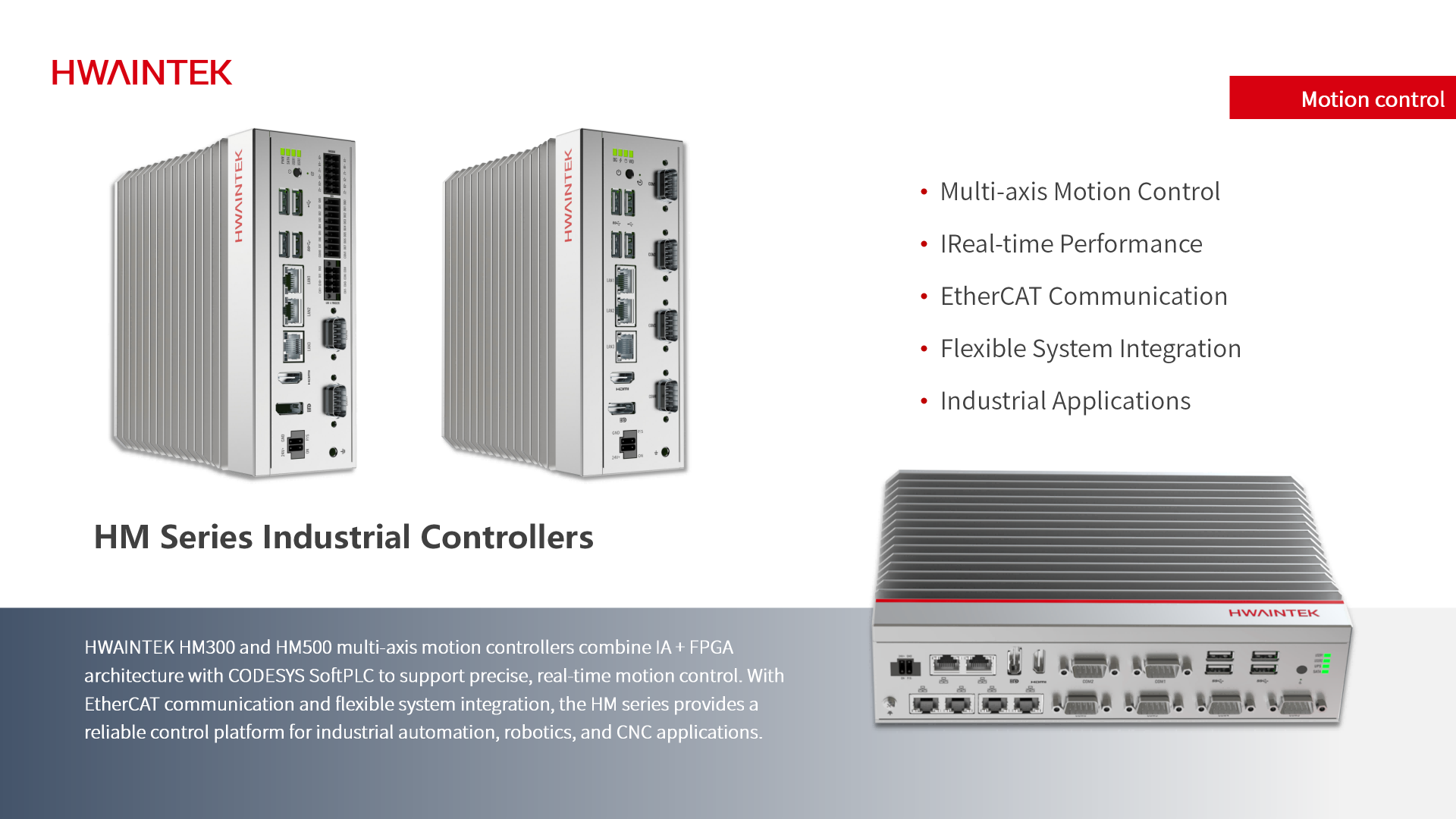
4.1 HM300: For compact equipment
installation flexibility are important, such as compact special-purpose machines, lithium-battery winding equipment and AGVs. Confirm suitability against the required axis count, motion tasks and interface configuration.
| Specification | HM300 Series (configuration varies by model) |
| Processor | Intel J6412; selected models offer N97 / i3-N305 |
| Maximum axis count | Up to 128 axes |
| Memory | Up to 32 GB on relevant configurations; selected DDR5 models up to 16 GB |
| Network | Example maximum configuration: 2 × Intel I210-AT + 1 × Intel I226-V Gigabit Ethernet |
| Power / consumption | DC 9–36 V input; maximum power consumption 60 W |
| Dimensions / mounting | Example standard size: 172 × 125 × 62.5 mm; DIN-rail mounting; some configurations differ |
| Typical applications | Compact automation equipment, multi-axis machines, motion control integrated with machine vision |
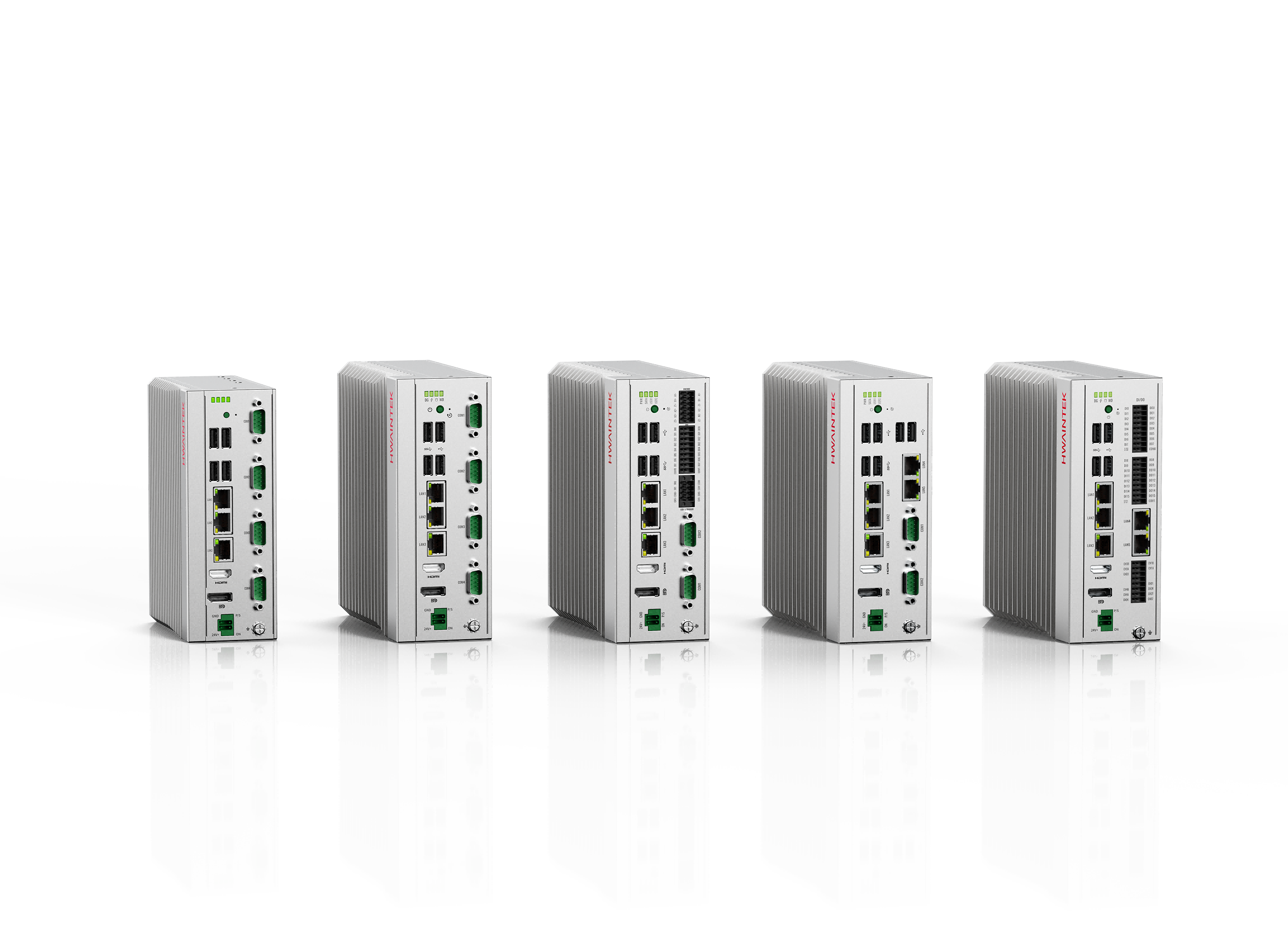
HM300 models can be differentiated by their interface requirements. Check the relevant datasheet for exact interface counts and rates.
4.2 HM500: For higher computing capacity and complex tasks
Compared with HM300, HM500 is better suited to systems with more axes, more complex motion tasks, or concurrent workloads such as machine vision, data acquisition and host communications.
| Specification | HM500 Series |
| Processor | 11th Gen Intel Core i3 / i5 / i7 |
| Maximum axis count | Up to 256 axes |
| Memory | 2 × SODIMM DDR4, up to 64 GB |
| Network | 4 × Intel Gigabit Ethernet ports |
| Storage | M.2 SSD and other storage options, depending on HM511D / HM512 |
| Power / consumption | 24 V DC input; maximum power consumption 120 W |
| Dimensions / mounting | Approx. 236 × 165 × 63.5 mm; DIN-rail mounting, optional wall mounting |
| Typical applications | Complex multi-axis equipment, multi-station production lines and systems running motion control alongside other tasks |
HM511D and HM512 offer the same motion-control capability, with differences mainly in storage, display, USB, serial-port and expansion configurations. Choose according to peripheral and expansion requirements rather than reviewing every interface detail in the selection article
4.3 HM300 vs. HM500: Which Should You Choose?
As a general guide, consider HM300 when the axis count, interfaces and computing load fit its capabilities and compact size or power consumption is a priority. Consider HM500 when more axes or greater computing capacity are required for complex control and concurrent host tasks. Final selection should be validated against the actual program workload and the datasheet for the exact model.
5. Typical Applications of Multi-axis Motion Controllers
5.1 Robotics, AGVs/AMRs and CNC
Industrial robots require coordinated movement across multiple joints. AGVs and AMRs may need to handle navigation and obstacle avoidance in addition to motion control, while CNC equipment focuses on trajectory accuracy, machining cycle time and system flexibility. For platforms combining an industrial PC and motion control, evaluate task loads, real-time requirements and system-integration needs.
5.2 Lithium-battery and semiconductor manufacturing
Lithium-battery winding and semiconductor die-bonding equipment often require multi-axis synchronization, accurate positioning, responsive I/O and stable continuous operation. Selection should account for axis count, process cycle time, trigger signals and operating conditions rather than relying on axis count or processor model alone.
5.3 Textile, packaging and logistics sorting
Textile and packaging machines typically require continuous operation and stable cycle times, while logistics-sorting systems may involve multiple stations and rapid response. An open motion-control platform can provide flexible hardware and software combinations, but configuration should still be based on the process and interface requirements.
6.Frequently Asked Questions (FAQ)
Q1. What to check for frequent EtherCAT disconnections or multi-axis sync errors?
Check shielded cables, connectors, power/signal separation, slave error counters, DC settings and communication cycle. If issues remain, use EtherCAT diagnostic tools to locate faulty nodes and check network topology and EMC environment. Good controller networking aids stability, yet correct wiring and commissioning are essential.
Q2. How to troubleshoot motors failing to run after enable, poor positioning or axis vibration?
Check drive alarms and enable signals first. Confirm encoder resolution, electronic gear ratio, control parameters and mechanical connections. If these are fine, check control cycle, task load and real-time jitter. Test step by step; avoid modifying multiple parameters together.
Q3. What leads to encoder position jumps, unexpected controller reboot or high CPU usage?
Check encoder shielding & grounding, power supply, temperature and cooling. Also check too-short motion cycles, redundant background tasks and program exceptions. For systems running motion control with vision or data acquisition, balance real-time and non-real-time tasks to manage total load.
7. Conclusion: Select Based on the Actual Machine Requirements
Choosing a multi-axis motion controller starts with axis count and motion type, followed by computing load, real-time communication and I/O, software requirements, and environmental conditions. HWAINTEK’s HM300 and HM500 series address different scales of multi-axis control: HM300 emphasizes compact equipment, while HM500 targets applications requiring more axes and greater computing capacity.
Before finalizing a model, compare the machine requirements with the official datasheet and validate the configuration using the actual application. For HM series configuration or selection support, contact HWAINTEK